 LANGUAGE
 Español
 عربى
عربى
Xinhong Valve & Fitting
Xinhong Valve & Fitting
Xinhong Valve & Fitting
Xinhong Valve & Fitting
Xinhong Valve & Fitting
Xinhong Valve & Fitting
Xinhong Valve & Fitting
Xinhong Valve & Fitting
Xinhong Valve & Fitting
Xinhong Valve & Fitting
Xinhong Valve & Fitting
Xinhong Valve & Fitting
Xinhong Valve & Fitting
Xinhong Valve & Fitting
Xinhong Valve & Fitting
Xinhong Valve & Fitting
-
 [email protected]
-
 +86-15058995341

Search
Category
Hot Products


Flanged Check Valve Manufacturer
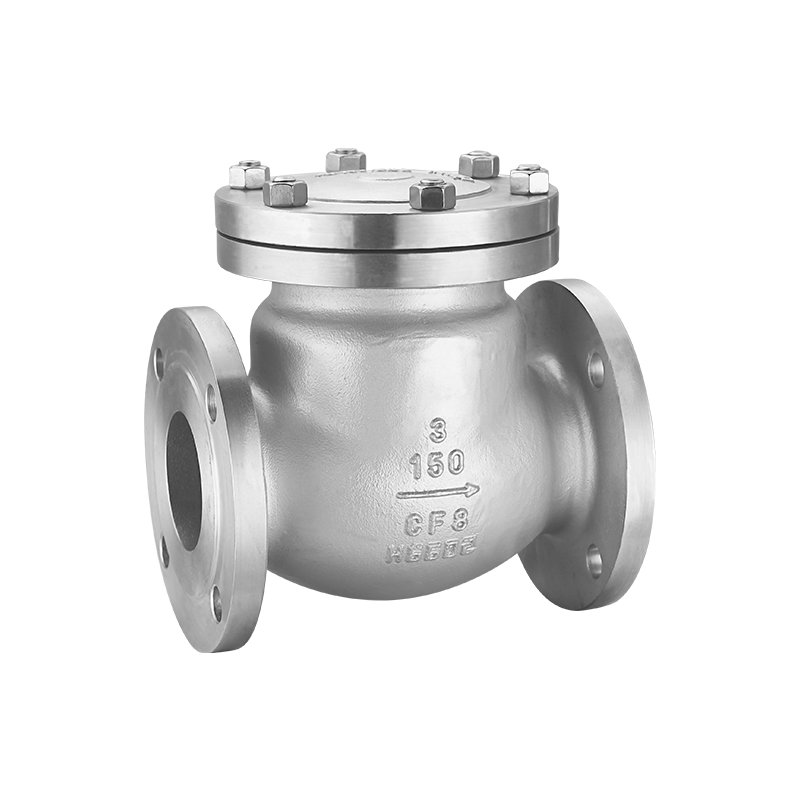
A flanged check valve is an automatic valve connected via a flange. Its core function is to control opening and closing based on the pressure differential of the medium itself, thereby preventing the backflow of liquid or gas within the pipeline. Compared to threaded or wafer-type connections, flanged check valves offer stronger connections and more stable sealing, making them particularly suitable for medium- and high-pressure, large-diameter, and critical piping systems.
In practical applications, flanged check valves not only prevent backflow but also effectively reduce water hammer, safeguarding the safe operation of pumps, valves, and heat exchange equipment. Due to the excellent sealing and pressure-bearing capacity of flange connections, this type of valve is particularly suitable for industrial pipelines requiring long-term stable operation, such as those in the petrochemical, power, metallurgical, and water treatment industries.
Flanged check valves are commonly available with a variety of internal configurations, such as lift and swing types, to meet the needs of different media and operating conditions. Their significant advantages include reliable operation, long maintenance intervals, and a wide range of applications, making them indispensable safety valves in various demanding industrial applications.


Company
Zhejiang Xinhong Valve & Fitting Co., Ltd.
Zhejiang Xinhong Valve & Fitting Co., Ltd. is a China Flange Check Valve Manufacturer and OEM/ODM Flange Check Valve Factory with 16 years of experience in valve production, sales, and service. The company occupies a land area of 2,000 square meters and has 120 staff. The company has a modern factory building, excellent machining equipment, a boring machine, a vertical lathe, a CNC lathe, plasma spray welding, chemical composition analysis, mechanical performance testing, hardness testing, an imported direct-reading spectrometer, and non-destructive testing. Ensure that products conform to the relevant design and inspection standards, so that the quality level of products is continuously improved.
News
-
The manual socket welding threaded ball valve has emerged as a preferred flow control component for medium-pressure piping systems...
READ MORE -
A ball valve is simple. A ball with a hole through it. A stem. A handle. Turn the handle ninety degrees, and the hole aligns with ...
READ MORE -
A globe valve controls flow. Turn the handle. A disc moves up and down. It seats against an opening. Flow stops or goes. A flanged...
READ MORE
Message Feedback
Flange Check Valve Industry Knowledge Extension
Flanged Check Valve: Function, Design, and Application
- Primary Function and Operating Principle:
The core function is backflow prevention. The valve opens when upstream pressure (inlet pressure) exceeds the downstream pressure plus the cracking pressure required to move the internal closing mechanism. When forward flow stops or reverses, the closing mechanism—a disc, wafer, or ball—is forced back onto its seat by backpressure or gravity, sealing the flow path.
- Flanged End Connection:
The "flanged" designation refers to the method of connecting the valve to the pipeline. Flanges are flat, circular discs with bolt holes around the perimeter. They are attached to the valve body and mate with corresponding flanges on the pipe ends, joined by bolts and gaskets to create a strong, leak-resistant, and easily maintainable connection. This makes them suitable for larger pipe sizes, higher pressures, and systems where frequent disassembly may be required.
- Common Industrial Applications:
Due to their robustness and reliable sealing, flanged check valves are found in numerous sectors. They are installed on the discharge side of pumps to prevent backflow and protect the pump from reverse rotation. They are used in boiler feedlines, condensate return systems, and cooling water networks. Furthermore, they serve in process lines to prevent mixing of different media from intersecting lines, ensuring product integrity in chemical or food processing plants.
What is a Flanged Swing Check Valve?
A flanged swing check valve is the prevalent design within the flanged check valve family. Its name derives from the operation of its internal sealing element, which swings on a hinge.
This valve features a disc that is suspended from a hinge pin located outside the flow path, typically at the top of the valve body. When fluid enters the valve, its pressure pushes against the disc, causing it to swing open on its hinge, pivoting upward and allowing flow to pass around it. The disc is designed to remain in a fully open position during normal forward flow, offering relatively low flow resistance. A significant design feature is that the disc's center of gravity, combined with the flow dynamics, allows it to float in the stream when open.
The sealing action occurs when the forward flow velocity drops. As flow diminishes, the disc begins to close under the force of gravity. If backflow begins, the reverse pressure pushes the disc swiftly and firmly onto the seat, creating a metal-to-metal (or composite) seal. For operation, these valves must be installed horizontally with the hinge pin axis horizontal, ensuring the disc can swing freely and gravity can assist in closing. Some designs incorporate an external lever and weight or a spring to assist in closing, which is particularly useful in vertical flow-up applications or to minimize water hammer—a pressure surge caused by a sudden stop in flow.
Their simple, robust design makes swing check valves suitable for clean liquid and gas services with relatively infrequent flow reversal. However, they are less ideal for pulsating flows, as the disc can chatter, causing wear and damage. Their full-bore design in larger sizes also requires considerable space for installation compared to more compact wafer-style check valves.
What are the typical pressure classes for steel flanged check valves?
Steel flanged check valves are manufactured to standardized pressure classes to ensure interchangeability and safety. Common classifications include ANSI (American National Standards Institute) classes such as 150, 300, and 600, or PN (Pressure Nominal) ratings like PN 16, PN 25, and PN 40. A Class 150 valve is rated for approximately 19 bar (275 psi) at ambient temperature, while a Class 300 rating is higher. The required class is determined by the operating pressure and temperature of the specific system.
Why choose a steel body over other materials?
Steel, typically carbon steel (e.g., ASTM A216 WCB) or stainless steel (e.g., ASTM A351 CF8/CF8M), is selected for its mechanical strength and durability. Carbon steel offers high tensile strength and impact resistance for high-pressure, high-temperature services common in power generation, oil and gas, and industrial steam lines. Stainless steel provides corrosion resistance for chemical, petrochemical, marine, or food-grade applications where fluid compatibility is a concern.
What are common trim options, and how are they selected?
"Trim" refers to the internal wetted parts, primarily the disc and seat. Common configurations include 13% chrome stainless steel trim for general service with some corrosion resistance, and hardened stainless steel or stellite-faced trim for erosive or high-pressure drop services. The trim material is chosen based on the fluid's corrosiveness, abrasiveness, and operating temperature to ensure longevity and reliable sealing.
When is a dual-plate check valve preferred over a swing check valve?
While both are flanged, a dual-plate (or double-door) check valve features two spring-assisted hinged plates. It is much more compact and lightweight than a comparable swing check valve. Its spring-assisted closure provides faster closing action, which is crucial for preventing severe water hammer in pump discharge systems. It is often preferred in space-constrained installations and for services with more frequent flow reversals.

In the spirit of win-win cooperation, Xinhong is willing to cooperate with you sincerely and work together to create a brilliant tomorrow.
Quick link
Products
Information
-
 +86-0577-86923185
-
 +86-15058995341
-
 +86-0577-86910175
-
 [email protected]
[email protected]
[email protected] -
 No.696, Binhai 5th Road, Wenzhou Economic & Technological Development Zone, Zhejiang, China
Mobile QR Code
Copyright © Zhejiang Xinhong Valve & Fitting Co., Ltd. All Rights Reserved.

Steel Flanged Check Valves Factory