 LANGUAGE
 Español
 عربى
عربى
Xinhong Valve & Fitting
Xinhong Valve & Fitting
Xinhong Valve & Fitting
Xinhong Valve & Fitting
Xinhong Valve & Fitting
Xinhong Valve & Fitting
Xinhong Valve & Fitting
Xinhong Valve & Fitting
Xinhong Valve & Fitting
Xinhong Valve & Fitting
Xinhong Valve & Fitting
Xinhong Valve & Fitting
Xinhong Valve & Fitting
Xinhong Valve & Fitting
Xinhong Valve & Fitting
Xinhong Valve & Fitting
-
 [email protected]
-
 +86-15058995341

Search
Category
Hot Products


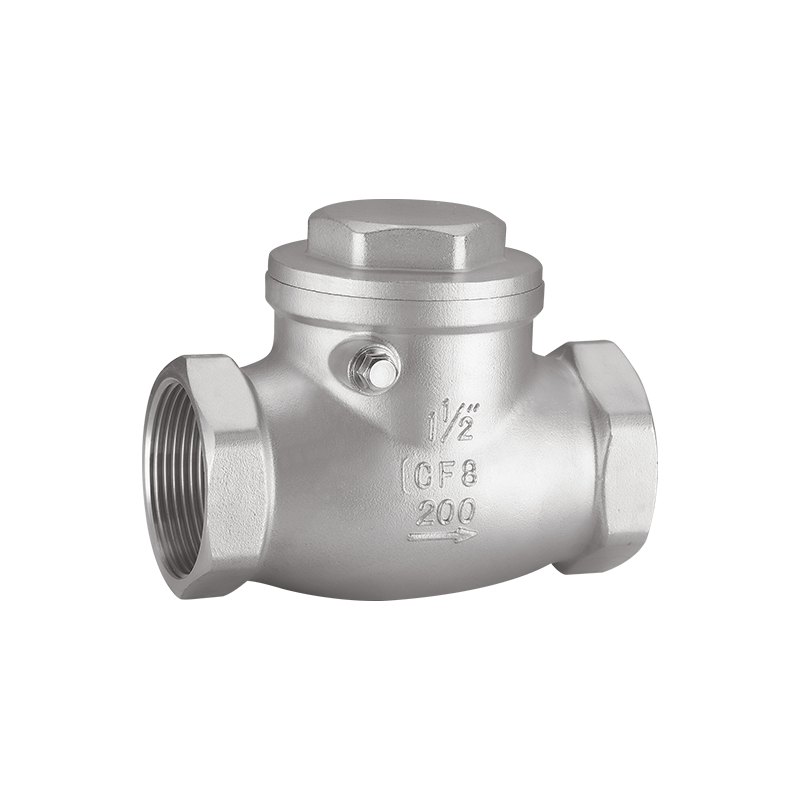
Threaded Swing Check Valves Factory
A screw end check valve is a valve that automatically opens and closes based on the medium's own flow pressure. Its primary function is to prevent backflow of pipeline media, thereby protecting the safe operation of pumps, compressors, and related equipment. Its threaded connection allows for flexible installation and a compact structure, making it ideal for small-diameter and medium- and low-pressure piping systems.
Key features include:
Automatic opening and closing – requires no external power or manual operation, operating based on the medium's flow direction and pressure differential;
Reliable sealing – the disc and seat fit tightly together, effectively preventing backflow and leakage;
Low flow resistance – sensitive opening and closing under normal flow, reducing energy loss;
Easy installation and maintenance – the threaded connection is quick and convenient, making it suitable for applications with limited space or where quick installation is required.
Common materials for screw end check valves include stainless steel, copper alloy, and carbon steel. They can handle water, oil, air, and some chemical media, and are widely used in residential water supply, HVAC, fire protection, food, and light industrial piping systems.

Company
Zhejiang Xinhong Valve & Fitting Co., Ltd.
Zhejiang Xinhong Valve & Fitting Co., Ltd. is a China Screw End Check Valve Manufacturer and OEM/ODM Screw End Check Valve Factory with 16 years of experience in valve production, sales, and service. The company occupies a land area of 2,000 square meters and has 120 staff. The company has a modern factory building, excellent machining equipment, a boring machine, a vertical lathe, a CNC lathe, plasma spray welding, chemical composition analysis, mechanical performance testing, hardness testing, an imported direct-reading spectrometer, and non-destructive testing. Ensure that products conform to the relevant design and inspection standards, so that the quality level of products is continuously improved.
News
-
The throttling screw end gate valve has gained recognition in process industries as a compact solution for both isolation and mode...
READ MORE -
The manual socket welding threaded ball valve has emerged as a preferred flow control component for medium-pressure piping systems...
READ MORE -
A ball valve is simple. A ball with a hole through it. A stem. A handle. Turn the handle ninety degrees, and the hole aligns with ...
READ MORE
Message Feedback
Screw End Check Valve Industry Knowledge Extension
The sustainability and efficiency of industrial components are crucial for both environmental and economic reasons. In the realm of fluid control, valves play a pivotal role. Among various valve types, threaded end check valves, specifically threaded swing check valves, have gained significant attention due to their unique advantages in process control applications.
Sustainability of Threaded End Check Valve Design
Threaded end check valves are known for their simplicity and robustness, which are key factors in sustainable design. Their sustainability is derived from several aspects:
- Material Efficiency: Threaded end check valves are constructed from a variety of materials, including stainless steel, brass, and other alloys. These materials are chosen not only for their strength and corrosion resistance but also for their recyclability, reducing the environmental footprint over the valve's lifecycle.
- Energy Efficiency: These valves minimize energy loss by allowing unidirectional flow and preventing backflow. This feature conserves energy by reducing the need for additional pumps or pressure control systems.
- Longevity and Low Maintenance: Threaded end check valves are designed for longevity, reducing the frequency of replacement and thus the waste generated. Their simple design also means fewer parts that can fail, lower maintenance costs and environmental impact.
- Eco-Friendly Operation: The operation of these valves produces minimal noise and vibration, contributing to a more eco-friendly industrial environment.
The sustainability of threaded end check valves is further enhanced by the ongoing development of eco-friendly materials and manufacturing processes that reduce waste and energy consumption.
The Role of Threaded Swing Check Valves in Improving Process Efficiency
Threaded swing check valves are a subtype of check valves that excel in improving process efficiency through several mechanisms:
Flow Control: They provide precise flow control by allowing fluid to flow in only one direction, which is crucial for maintaining process integrity in various industries, including water treatment, chemical processing, and oil and gas.
Backflow Prevention: By preventing backflow, they protect the system from potential damage, such as pump reversal, which can costly downtime and repairs.
Pressure Regulation: Swing check valves help in maintaining stable pressure within the system, which is vital for the efficient operation of pumps and other equipment.
Space-Saving Design: Their compact design allows for easy installation in tight spaces, which is particularly beneficial in industries where space is at a premium.
Cost-Effectiveness: The simplicity of threaded swing check valves translates into lower manufacturing and operational costs, contributing to overall process efficiency.
These features make threaded swing check valves an essential component in systems where efficiency and reliability are paramount.
SS Threaded Swing Check: Challenges and Solutions
Despite their numerous benefits, stainless steel (SS) threaded swing check valves face certain challenges that require innovative solutions:
- Corrosion Resistance: While stainless steel is resistant to corrosion, it is not immune. The solution lies in selecting the appropriate grade of stainless steel for the specific application and considering additional protective coatings when necessary.
- Erosion: High-velocity fluids can erode the valve seat over time. Engineers address this by using harder seat materials or designing the valve with an erosion-resistant geometry.
- Leakage: Leakage can occur if the valve does not seat properly. Regular maintenance and the use of high-quality seals can mitigate this issue.
- Temperature Limits: Stainless steel has temperature limitations, which can be overcome by using materials with higher temperature resistance or by designing the valve for the specific temperature range of the application.
- Cost: Stainless steel valves can be more expensive than their counterparts made from other materials. However, the long-term benefits of corrosion resistance and durability often justify the initial higher cost.
By addressing these challenges, the use of SS threaded swing check valves can be optimized, ensuring they continue to contribute to sustainable and efficient industrial processes.

In the spirit of win-win cooperation, Xinhong is willing to cooperate with you sincerely and work together to create a brilliant tomorrow.
Quick link
Products
Information
-
 +86-0577-86923185
-
 +86-15058995341
-
 +86-0577-86910175
-
 [email protected]
[email protected]
[email protected] -
 No.696, Binhai 5th Road, Wenzhou Economic & Technological Development Zone, Zhejiang, China
Mobile QR Code
Copyright © Zhejiang Xinhong Valve & Fitting Co., Ltd. All Rights Reserved.

SS Threaded Swing Check Custom